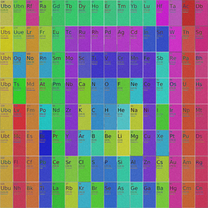
#!/usr/bin/env python3
# -*- coding: utf-8 -*-

from __future__ import annotations

import argparse
import math
import os
import sys
from dataclasses import dataclass
from pathlib import Path
from typing import Dict, List, Tuple, Optional

import numpy as np
from PIL import Image, ImageDraw, ImageFont
import colorsys

USE_NUMBA = False
try:
    from numba import njit  # type: ignore
    USE_NUMBA = True
except Exception:
    USE_NUMBA = False

WIDTH = 4096
HEIGHT = 4096
TOTAL_COLORS = WIDTH * HEIGHT  # 16,777,216

ELEMENT_COUNT = 128
GRID_COLS = 16
GRID_ROWS = 8
CELL_W = WIDTH // GRID_COLS   # 256
CELL_H = HEIGHT // GRID_ROWS  # 512

TEXT_MARGIN = 12
LINE_GAP = 10
AA_SCALE_DEFAULT = 2

# Thicker borders
BORDER_THICK_DEFAULT = 4  # px

# Bin quantization
BIN_SHIFT = 3
BINS_PER_CH = 256 >> BIN_SHIFT  # 32
NBINS = BINS_PER_CH * BINS_PER_CH * BINS_PER_CH  # 32768


ELEMENT_SYMBOLS = [
    "H", "He", "Li", "Be", "B", "C", "N", "O", "F", "Ne",
    "Na", "Mg", "Al", "Si", "P", "S", "Cl", "Ar", "K", "Ca",
    "Sc", "Ti", "V", "Cr", "Mn", "Fe", "Co", "Ni", "Cu", "Zn",
    "Ga", "Ge", "As", "Se", "Br", "Kr", "Rb", "Sr", "Y", "Zr",
    "Nb", "Mo", "Tc", "Ru", "Rh", "Pd", "Ag", "Cd", "In", "Sn",
    "Sb", "Te", "I", "Xe", "Cs", "Ba", "La", "Ce", "Pr", "Nd",
    "Pm", "Sm", "Eu", "Gd", "Tb", "Dy", "Ho", "Er", "Tm", "Yb",
    "Lu", "Hf", "Ta", "W", "Re", "Os", "Ir", "Pt", "Au", "Hg",
    "Tl", "Pb", "Bi", "Po", "At", "Rn", "Fr", "Ra", "Ac", "Th",
    "Pa", "U", "Np", "Pu", "Am", "Cm", "Bk", "Cf", "Es", "Fm",
    "Md", "No", "Lr", "Rf", "Db", "Sg", "Bh", "Hs", "Mt", "Ds",
    "Rg", "Cn", "Nh", "Fl", "Mc", "Lv", "Ts", "Og"
]

ELEMENT_NAMES = [
    "Hydrogen", "Helium", "Lithium", "Beryllium", "Boron", "Carbon", "Nitrogen", "Oxygen", "Fluorine", "Neon",
    "Sodium", "Magnesium", "Aluminium", "Silicon", "Phosphorus", "Sulfur", "Chlorine", "Argon", "Potassium", "Calcium",
    "Scandium", "Titanium", "Vanadium", "Chromium", "Manganese", "Iron", "Cobalt", "Nickel", "Copper", "Zinc",
    "Gallium", "Germanium", "Arsenic", "Selenium", "Bromine", "Krypton", "Rubidium", "Strontium", "Yttrium", "Zirconium",
    "Niobium", "Molybdenum", "Technetium", "Ruthenium", "Rhodium", "Palladium", "Silver", "Cadmium", "Indium", "Tin",
    "Antimony", "Tellurium", "Iodine", "Xenon", "Caesium", "Barium", "Lanthanum", "Cerium", "Praseodymium", "Neodymium",
    "Promethium", "Samarium", "Europium", "Gadolinium", "Terbium", "Dysprosium", "Holmium", "Erbium", "Thulium", "Ytterbium",
    "Lutetium", "Hafnium", "Tantalum", "Tungsten", "Rhenium", "Osmium", "Iridium", "Platinum", "Gold", "Mercury",
    "Thallium", "Lead", "Bismuth", "Polonium", "Astatine", "Radon", "Francium", "Radium", "Actinium", "Thorium",
    "Protactinium", "Uranium", "Neptunium", "Plutonium", "Americium", "Curium", "Berkelium", "Californium", "Einsteinium", "Fermium",
    "Mendelevium", "Nobelium", "Lawrencium", "Rutherfordium", "Dubnium", "Seaborgium", "Bohrium", "Hassium", "Meitnerium", "Darmstadtium",
    "Roentgenium", "Copernicium", "Nihonium", "Flerovium", "Moscovium", "Livermorium", "Tennessine", "Oganesson"
]


def generate_symbol(n: int) -> str:
    if n <= 118:
        return ELEMENT_SYMBOLS[n - 1]
    digit_to_letter = ['n', 'u', 'b', 't', 'q', 'p', 'h', 's', 'o', 'e']
    return ''.join(digit_to_letter[int(d)] for d in str(n)).capitalize()[:3]


def generate_name(n: int) -> str:
    if n <= 118:
        return ELEMENT_NAMES[n - 1]
    roots = ['nil', 'un', 'bi', 'tri', 'quad', 'pent', 'hex', 'sept', 'oct', 'enn']
    digits = [int(d) for d in str(n)]
    parts = [roots[d] for d in digits]
    if parts[-1] in ('bi', 'tri'):
        parts[-1] = parts[-1][:-1]
    for i in range(len(parts) - 1):
        if parts[i] == 'enn' and parts[i + 1] == 'nil':
            parts[i] = 'en'
    return ''.join(parts).capitalize() + "ium"


def generate_weight(n: int) -> str:
    return f"[{n:.1f}]"


def classify_element(n: int) -> str:
    if n == 1: return "nonmetal"
    if n in [2,10,18,36,54,86,118]: return "noble_gas"
    if n in [5,14,32,33,51,52,84]: return "metalloid"
    if n in [9,17,35,53,85,117]: return "halogen"
    if n in [6,7,8,15,16,34]: return "nonmetal"
    if n in [3,11,19,37,55,87,119]: return "alkali"
    if n in [4,12,20,38,56,88,120]: return "alkaline"
    if 57 <= n <= 71: return "lanthanide"
    if 89 <= n <= 103: return "actinide"
    if 104 <= n <= 112 or (21 <= n <= 30) or (39 <= n <= 48) or (72 <= n <= 80): return "transition"
    if (13 <= n <= 16) or (31 <= n <= 34) or (49 <= n <= 52) or (81 <= n <= 84): return "post_transition"
    if 121 <= n <= 138: return "actinide"
    return "unknown"


def generate_spiral_grid(cols: int, rows: int) -> List[List[int]]:
    grid = [[-1] * cols for _ in range(rows)]
    cx, cy = cols // 2, rows // 2
    x, y = cx, cy
    dx = [1, 0, -1, 0]
    dy = [0, 1, 0, -1]
    steps = 1
    dir_idx = 0
    count = 1
    while count <= cols * rows:
        for _ in range(2):
            for _ in range(steps):
                if 0 <= x < cols and 0 <= y < rows:
                    grid[y][x] = count
                    count += 1
                    if count > cols * rows:
                        return grid
                x += dx[dir_idx]
                y += dy[dir_idx]
            dir_idx = (dir_idx + 1) % 4
        steps += 1
    return grid


def dilate8(mask: np.ndarray) -> np.ndarray:
    p = np.pad(mask, 1, mode="constant", constant_values=False)
    c = p[1:-1, 1:-1]
    n = p[:-2, 1:-1]
    s = p[2:, 1:-1]
    w = p[1:-1, :-2]
    e = p[1:-1, 2:]
    nw = p[:-2, :-2]
    ne = p[:-2, 2:]
    sw = p[2:, :-2]
    se = p[2:, 2:]
    return c | n | s | w | e | nw | ne | sw | se


def _candidate_font_dirs() -> List[Path]:
    dirs: List[Path] = []
    windir = os.environ.get("WINDIR", r"C:\Windows")
    dirs.append(Path(windir) / "Fonts")
    dirs += [Path("/Library/Fonts"), Path.home() / "Library" / "Fonts"]
    dirs += [Path("/usr/share/fonts"), Path("/usr/local/share/fonts"), Path.home() / ".fonts"]
    return [d for d in dirs if d.exists()]


def find_font_file(name_substr: str, prefer_bold: bool) -> Optional[str]:
    name_substr_l = name_substr.lower()
    exts = (".ttf", ".otf", ".ttc")
    best: Optional[Path] = None
    best_score = -1
    for d in _candidate_font_dirs():
        try:
            if sys.platform.startswith("win"):
                paths = [d / p for p in os.listdir(d)]
            else:
                paths = list(d.glob("*")) + list(d.glob("*/*")) + list(d.glob("*/*/*"))
        except Exception:
            continue
        for p in paths:
            if not p.is_file() or p.suffix.lower() not in exts:
                continue
            fn = p.name.lower()
            if name_substr_l not in fn:
                continue
            score = 0
            if prefer_bold:
                if "bold" in fn: score += 50
                if "semibold" in fn or "demi" in fn: score += 30
            else:
                if "regular" in fn or "book" in fn: score += 20
                if "bold" in fn: score -= 10
            if "myriad" in fn: score += 10
            if "pro" in fn: score += 5
            if score > best_score:
                best_score = score
                best = p
    return str(best) if best else None


@dataclass
class Fonts:
    small: ImageFont.FreeTypeFont
    regular: ImageFont.FreeTypeFont
    bold: ImageFont.FreeTypeFont


def load_fonts(cell_h: int, font_regular_path: Optional[str], font_bold_path: Optional[str], aa_scale: int) -> Fonts:
    fs_symbol = max(28, int(cell_h * 0.20)) * aa_scale
    fs_reg = max(18, int(cell_h * 0.08)) * aa_scale
    fs_small = max(14, int(cell_h * 0.05)) * aa_scale

    reg_path = font_regular_path or find_font_file("Myriad", prefer_bold=False) or "DejaVuSans.ttf"
    bold_path = font_bold_path or find_font_file("Myriad", prefer_bold=True) or reg_path

    small = ImageFont.truetype(reg_path, fs_small)
    regular = ImageFont.truetype(reg_path, fs_reg)
    bold = ImageFont.truetype(bold_path, fs_symbol)
    return Fonts(small=small, regular=regular, bold=bold)


def render_text_mask(cell_w: int, cell_h: int, n: int, fonts: Fonts, aa_scale: int) -> np.ndarray:
    Wb = cell_w * aa_scale
    Hb = cell_h * aa_scale
    mask_big = Image.new("L", (Wb, Hb), 0)
    draw = ImageDraw.Draw(mask_big)

    lines = [
        (str(n), fonts.regular),
        (generate_symbol(n), fonts.bold),
        (generate_weight(n), fonts.regular),
        (generate_name(n), fonts.small),
    ]

    x = TEXT_MARGIN * aa_scale
    y = TEXT_MARGIN * aa_scale
    for text, font in lines:
        draw.text((x, y), text, font=font, fill=255)
        y += int(font.size + (LINE_GAP * aa_scale))

    mask_small = mask_big.resize((cell_w, cell_h), resample=Image.BOX)
    arr = np.asarray(mask_small, dtype=np.uint8)
    return arr >= 96


def compute_masks_for_cell(n: int, fonts: Fonts, aa_scale: int, border_thick: int) -> Tuple[np.ndarray, np.ndarray, np.ndarray, np.ndarray]:
    label = render_text_mask(CELL_W, CELL_H, n, fonts, aa_scale)

    t = max(1, int(border_thick))
    border = np.zeros((CELL_H, CELL_W), dtype=bool)
    border[:t, :] = True
    border[-t:, :] = True
    border[:, :t] = True
    border[:, -t:] = True

    label = label & (~border)
    outline = dilate8(label) & (~label) & (~border)
    fill = ~(label | outline | border)
    return label, outline, border, fill


def bin_of_color_ids(ids: np.ndarray) -> np.ndarray:
    r = (ids >> 16) & 0xFF
    g = (ids >> 8) & 0xFF
    b = ids & 0xFF
    br = r >> BIN_SHIFT
    bg = g >> BIN_SHIFT
    bb = b >> BIN_SHIFT
    return (br << 10) | (bg << 5) | bb


if USE_NUMBA:
    @njit
    def _bin_of_color_numba(c: np.uint32) -> np.int32:
        r = (c >> 16) & 0xFF
        g = (c >> 8) & 0xFF
        b = c & 0xFF
        br = r >> BIN_SHIFT
        bg = g >> BIN_SHIFT
        bb = b >> BIN_SHIFT
        return (br << 10) | (bg << 5) | bb

    @njit
    def build_bin_pool_from_perm_numba(perm: np.ndarray) -> Tuple[np.ndarray, np.ndarray, np.ndarray]:
        counts = np.zeros(NBINS, dtype=np.int32)
        n = perm.shape[0]
        for i in range(n):
            counts[_bin_of_color_numba(perm[i])] += 1

        start = np.empty(NBINS, dtype=np.int32)
        end = np.empty(NBINS, dtype=np.int32)
        s = 0
        for b in range(NBINS):
            start[b] = s
            s += counts[b]
            end[b] = s

        nxt = start.copy()
        grouped = np.empty(n, dtype=np.uint32)
        for i in range(n):
            c = perm[i]
            b = _bin_of_color_numba(c)
            j = nxt[b]
            grouped[j] = c
            nxt[b] = j + 1

        return grouped, start, end


def build_bin_pool_from_perm(perm: np.ndarray) -> Tuple[np.ndarray, np.ndarray, np.ndarray]:
    if USE_NUMBA:
        return build_bin_pool_from_perm_numba(perm)

    bins = bin_of_color_ids(perm).astype(np.int32)
    counts = np.bincount(bins, minlength=NBINS).astype(np.int32)
    start = np.zeros(NBINS, dtype=np.int32)
    start[1:] = np.cumsum(counts[:-1])
    end = start + counts
    order = np.argsort(bins, kind="stable")
    grouped = perm[order]
    return grouped, start, end


@dataclass
class BinAllocator:
    grouped: np.ndarray
    cur: np.ndarray
    end: np.ndarray


class BinStream:
    def __init__(self, alloc: BinAllocator, bins_order: np.ndarray):
        self.a = alloc
        self.bins = bins_order.astype(np.int32, copy=False)
        self.i = 0

    def take(self, k: int) -> np.ndarray:
        out = np.empty(k, dtype=np.uint32)
        o = 0
        while o < k:
            if self.i >= self.bins.shape[0]:
                raise RuntimeError("BinStream exhausted bins_order.")
            b = int(self.bins[self.i])
            avail = int(self.a.end[b] - self.a.cur[b])
            if avail <= 0:
                self.i += 1
                continue
            n = min(avail, k - o)
            s = int(self.a.cur[b]); e = s + n
            out[o:o+n] = self.a.grouped[s:e]
            self.a.cur[b] = e
            o += n
            if self.a.cur[b] >= self.a.end[b]:
                self.i += 1
        return out


@dataclass
class CellInfo:
    n: int
    col: int
    row: int
    series: str


def build_cells() -> List[CellInfo]:
    spiral = generate_spiral_grid(GRID_COLS, GRID_ROWS)
    pos_by_element: Dict[int, Tuple[int, int]] = {}
    for y in range(GRID_ROWS):
        for x in range(GRID_COLS):
            n = spiral[y][x]
            if 1 <= n <= ELEMENT_COUNT:
                pos_by_element[n] = (x, y)
    cells: List[CellInfo] = []
    for n in range(1, ELEMENT_COUNT + 1):
        col, row = pos_by_element[n]
        cells.append(CellInfo(n=n, col=col, row=row, series=classify_element(n)))
    return cells


def cell_bounds(col: int, row: int) -> Tuple[int, int, int, int]:
    x0 = col * CELL_W
    y0 = row * CELL_H
    return x0, y0, x0 + CELL_W, y0 + CELL_H


def main():
    ap = argparse.ArgumentParser()
    ap.add_argument("--out", default="periodic_table_allrgb_128_spiral.png")
    ap.add_argument("--seed", type=int, default=1)
    ap.add_argument("--aa", type=int, default=AA_SCALE_DEFAULT)
    ap.add_argument("--border", type=int, default=BORDER_THICK_DEFAULT, help="Border thickness in pixels (default: 4)")
    ap.add_argument("--font-regular", default=None)
    ap.add_argument("--font-bold", default=None)
    args = ap.parse_args()

    aa_scale = max(1, int(args.aa))
    border_thick = max(1, int(args.border))

    cells = build_cells()
    fonts = load_fonts(CELL_H, args.font_regular, args.font_bold, aa_scale)

    # Count masks + series demand
    total_label = total_outline = total_border = 0
    fill_by_series: Dict[str, int] = {}
    for c in cells:
        label, outline, border, fill = compute_masks_for_cell(c.n, fonts, aa_scale, border_thick)
        total_label += int(label.sum())
        total_outline += int(outline.sum())
        total_border += int(border.sum())
        fill_by_series[c.series] = fill_by_series.get(c.series, 0) + int(fill.sum())

    if total_label + total_outline + total_border + sum(fill_by_series.values()) != TOTAL_COLORS:
        raise RuntimeError("Mask accounting mismatch.")

    # Bin metrics
    def precompute_bin_metrics():
        hue = np.zeros(NBINS, dtype=np.float32)
        sat = np.zeros(NBINS, dtype=np.float32)
        val = np.zeros(NBINS, dtype=np.float32)
        for b in range(NBINS):
            br = (b >> 10) & 31
            bg = (b >> 5) & 31
            bb = b & 31
            rc = (br << BIN_SHIFT) + (1 << (BIN_SHIFT - 1))
            gc = (bg << BIN_SHIFT) + (1 << (BIN_SHIFT - 1))
            bc = (bb << BIN_SHIFT) + (1 << (BIN_SHIFT - 1))
            h, s, v = colorsys.rgb_to_hsv(rc / 255.0, gc / 255.0, bc / 255.0)
            hue[b] = h; sat[b] = s; val[b] = v
        return hue, sat, val

    hue, sat, val = precompute_bin_metrics()
    bins = np.arange(NBINS, dtype=np.int32)

    # Dark/light/border bin orders (unchanged)
    dark_bins = bins[np.lexsort((-(sat.astype(np.float64)), val.astype(np.float64)))]
    light_bins = bins[np.lexsort((sat.astype(np.float64), -val.astype(np.float64)))]
    border_bins = bins[np.lexsort((-val.astype(np.float64), np.abs(val.astype(np.float64) - 0.5), sat.astype(np.float64)))]

    # FILL bin order: push low-saturation (gray-ish) bins to the end
    # Primary: is_gray (0 first, 1 last), then hue, then prefer higher sat/val.
    S_GRAY = 0.20
    is_gray = (sat < S_GRAY).astype(np.int32)
    fill_bins = bins[np.lexsort((
        -val.astype(np.float64),
        -sat.astype(np.float64),
        hue.astype(np.float64),
        is_gray.astype(np.float64),  # primary (last key): colorful first, grays last
    ))]

    rng = np.random.default_rng(args.seed)
    perm = rng.permutation(TOTAL_COLORS).astype(np.uint32)
    grouped, start, end = build_bin_pool_from_perm(perm)

    alloc = BinAllocator(grouped=grouped, cur=start.copy(), end=end)
    label_stream = BinStream(alloc, dark_bins)
    outline_stream = BinStream(alloc, light_bins)
    border_stream = BinStream(alloc, border_bins)
    fill_stream = BinStream(alloc, fill_bins)

    label_colors = label_stream.take(total_label)
    outline_colors = outline_stream.take(total_outline)
    border_colors = border_stream.take(total_border)

    series_order = sorted(fill_by_series.keys())
    series_fill_colors: Dict[str, np.ndarray] = {}
    for s in series_order:
        series_fill_colors[s] = fill_stream.take(fill_by_series[s])

    img_ids = np.zeros((HEIGHT, WIDTH), dtype=np.uint32)

    idx_label = idx_outline = idx_border = 0
    idx_fill = {s: 0 for s in series_order}

    for c in cells:
        x0, y0, x1, y1 = cell_bounds(c.col, c.row)
        cell = img_ids[y0:y1, x0:x1]  # view

        label, outline, border, fill = compute_masks_for_cell(c.n, fonts, aa_scale, border_thick)

        # Fill
        fill_idx = np.flatnonzero(fill)
        kf = fill_idx.size
        if kf:
            chunk = series_fill_colors[c.series][idx_fill[c.series]: idx_fill[c.series] + kf]
            idx_fill[c.series] += kf
            rr = np.random.default_rng((args.seed * 1000003 + c.n) & 0xFFFFFFFF)
            rr.shuffle(fill_idx)
            yy = fill_idx // CELL_W
            xx = fill_idx % CELL_W
            cell[yy, xx] = chunk

        # Border (now thicker)
        border_idx = np.flatnonzero(border)
        kb = border_idx.size
        if kb:
            yy = border_idx // CELL_W
            xx = border_idx % CELL_W
            cell[yy, xx] = border_colors[idx_border: idx_border + kb]
            idx_border += kb

        # Outline
        outline_idx = np.flatnonzero(outline)
        ko = outline_idx.size
        if ko:
            yy = outline_idx // CELL_W
            xx = outline_idx % CELL_W
            cell[yy, xx] = outline_colors[idx_outline: idx_outline + ko]
            idx_outline += ko

        # Label
        label_idx = np.flatnonzero(label)
        kl = label_idx.size
        if kl:
            yy = label_idx // CELL_W
            xx = label_idx % CELL_W
            cell[yy, xx] = label_colors[idx_label: idx_label + kl]
            idx_label += kl

    # Convert packed ids -> RGB
    rgb = np.empty((HEIGHT, WIDTH, 3), dtype=np.uint8)
    rgb[..., 0] = ((img_ids >> 16) & 0xFF).astype(np.uint8)
    rgb[..., 1] = ((img_ids >> 8) & 0xFF).astype(np.uint8)
    rgb[..., 2] = (img_ids & 0xFF).astype(np.uint8)

    Image.fromarray(rgb, "RGB").save(args.out)
    print(f"✅ Saved: {args.out}")


if __name__ == "__main__":
    main()