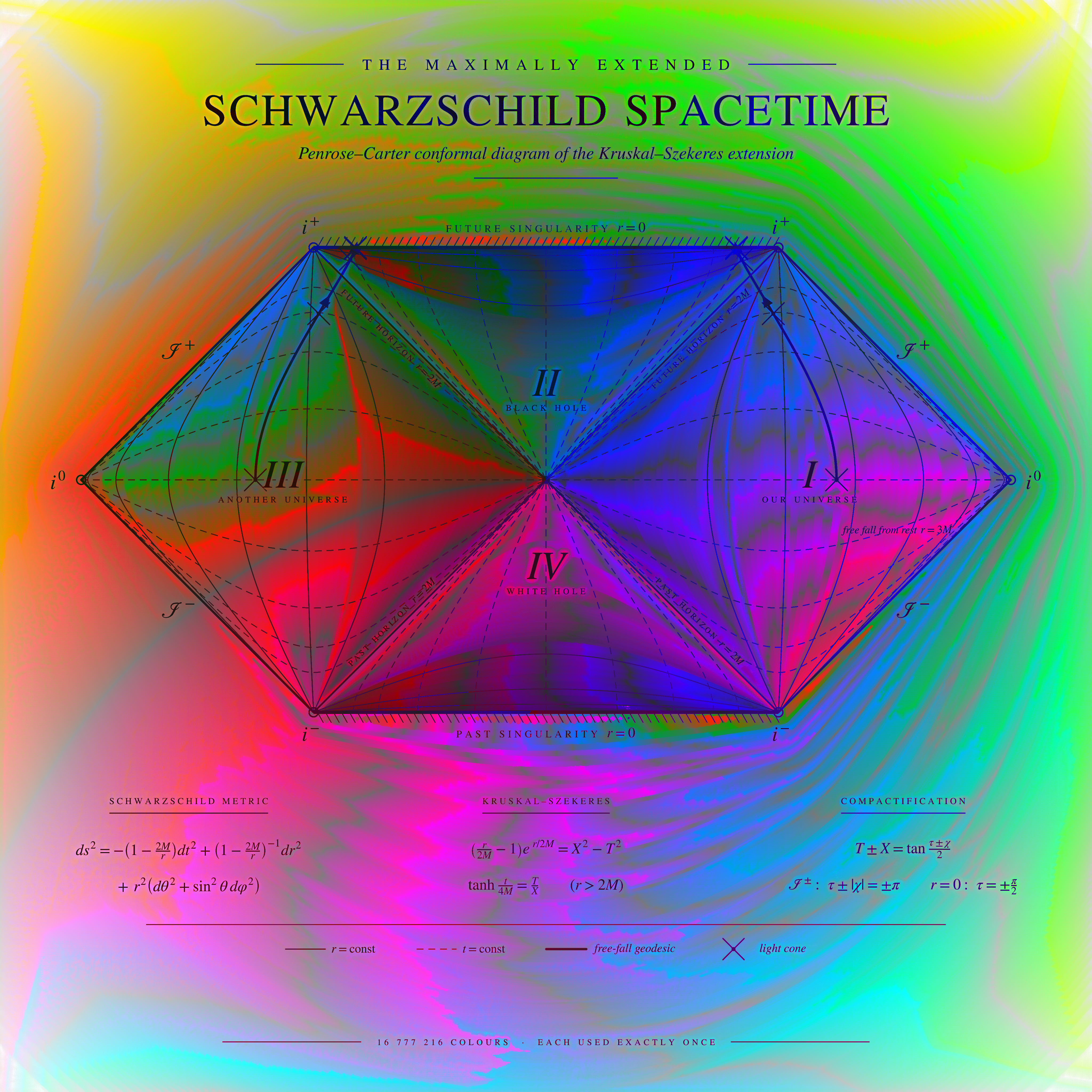
Another throw at visualizing a https://en.wikipedia.org/wiki/Penrose_diagram. With Claude Sonnet 5.5 this time.
#!/usr/bin/env python3
"""
Penrose diagram  --  an all-RGB image (4096 x 4096, every 24-bit colour exactly once)

The subject is the maximally extended Schwarzschild spacetime (Kruskal-Szekeres
extension), drawn as a Penrose-Carter conformal diagram.  Everything is computed
analytically, nothing is traced by eye.

Mathematics (units 2M = 1, rho = r / 2M)
----------------------------------------
Kruskal-Szekeres null coordinates      a = T + X ,  b = X - T
    (rho - 1) e^rho = X^2 - T^2 = a b          (defines r(T, X))
Conformal compactification            T + X = tan((tau + chi)/2)
                                      X - T = tan((chi - tau)/2)
    * the whole manifold maps to the hexagon  |tau| <= pi/2,  |tau| + |chi| <= pi
    * the singularity r = 0  <=>  a b = -1  <=>  tau = +-pi/2   (exactly straight)
    * null infinity  I+- :  tau + |chi| = pi,   |chi| - tau = pi
    * horizons r = 2M  <=>  a = 0  or  b = 0   (the two 45-degree diagonals)
Curves drawn
    r = const  outside   :  (X, T) = sqrt(G) (cosh s, sinh s),      G = (rho-1)e^rho > 0
    r = const  inside    :  (X, T) = sqrt(-G) (sinh s, +-cosh s),   G < 0
    t = const            :  straight lines through the bifurcation sphere,
                            T = tanh(t/4M) X  outside,   X = tanh(t/4M) T  inside
    free fall from rest at r = R0 (exact cycloid, continued through the horizon):
        rho = rho0 (1 + cos eta)/2 ,   q = sqrt(rho0 - 1) ,   x = tan(eta/2)
        Phi = q [eta + (rho0/2)(eta + sin eta)]
        a = (q + x) e^{(rho + Phi)/2} / sqrt(1 + x^2)
        b = (q - x) e^{(rho - Phi)/2} / sqrt(1 + x^2)
        (finite and smooth across the horizon, ends exactly on a b = -1)
Region shading uses the exact r(T, X) from the Lambert W function:
    rho = 1 + W0(G / e).

How the picture becomes all-RGB
-------------------------------
Vector layers (lines, type) are rasterised at 4096^2 with analytic anti-aliasing
(matplotlib / Agg).  They are merged into three smooth scalar fields for every
pixel: a luma key (structure), a hue key (a conic spectrum) and a saturation key.
Pixels and the 2^24 colours are each sorted by luma, cut into groups, sorted by
hue inside the groups, cut again and sorted by saturation, then matched
rank-for-rank, so every colour is used exactly once and edges stay crisp.

Usage:
    python penrose.py                    # writes penrose.png next to this script
    python penrose.py --verify           # also checks every colour appears exactly once
    python penrose.py --serif "Georgia"  # use another installed serif font for the type

Requires: numpy, Pillow, matplotlib.   Needs roughly 2.5 GB of RAM.
"""

import argparse
import os
import time

import numpy as np
import matplotlib

matplotlib.use("Agg")
import matplotlib.pyplot as plt
from matplotlib.font_manager import FontProperties
from matplotlib.patches import Circle, PathPatch
from matplotlib.path import Path
from matplotlib.textpath import TextPath, text_to_path
from matplotlib.transforms import Affine2D
from PIL import Image

PI = np.pi
W = H = 4096                  # 4096 * 4096 == 2**24 == number of 24-bit colours
NN = W * H
DPI = 100


# ---- layout (pixels) -----------------------------------------------------
S = 555.0                     # pixels per unit of tau / chi
CX, CY = 2048.0, 1800.0       # screen position of the bifurcation sphere

matplotlib.rcParams["mathtext.fontset"] = "stix"
matplotlib.rcParams["lines.scale_dashes"] = False
matplotlib.rcParams["path.simplify"] = False


# --------------------------------------------------------------------------
# Mathematics
# --------------------------------------------------------------------------
def lambertw0(x):
    """Principal branch of the Lambert W function (vectorised Halley iteration)."""
    x = np.maximum(np.asarray(x, dtype=np.float64), -1.0 / np.e + 1e-15)
    p = np.sqrt(np.maximum(2.0 * (np.e * x + 1.0), 0.0))
    w_branch = -1.0 + p - p * p / 3.0 + 11.0 * p ** 3 / 72.0
    w_neg = x / (1.0 + x)
    w_pos = np.log1p(np.maximum(x, 0.0))
    w = np.where(x < -0.25, w_branch, np.where(x < 0, w_neg, w_pos))
    for _ in range(12):
        ew = np.exp(w)
        f = w * ew - x
        den = ew * (w + 1.0) - (w + 2.0) * f / (2.0 * w + 2.0)
        w = w - f / den
    return w


def penrose_from_null(a, b):
    """(tau, chi) from the Kruskal null coordinates a = T + X, b = X - T."""
    al, be = np.arctan(a), np.arctan(b)
    return al - be, al + be


def penrose_from_kruskal(T, X):
    return penrose_from_null(T + X, X - T)


def screen(tau, chi):
    return CX + S * np.asarray(chi), CY - S * np.asarray(tau)


def G_of_rho(rho):
    return (rho - 1.0) * np.exp(rho)


def curve_r_outside(rho, n=6000, smax=13.0):
    """r = const > 2M : a timelike hyperbola from i- to i+ (right exterior)."""
    sg = np.sqrt(G_of_rho(rho))
    s = np.linspace(-smax, smax, n)
    return penrose_from_kruskal(sg * np.sinh(s), sg * np.cosh(s))


def curve_r_inside(rho, upper=True, n=6000, smax=13.0):
    """r = const < 2M : a spacelike hyperbola inside the black (upper) / white hole."""
    sg = np.sqrt(-G_of_rho(rho))
    s = np.linspace(-smax, smax, n)
    T = sg * np.cosh(s) * (1 if upper else -1)
    return penrose_from_kruskal(T, sg * np.sinh(s))


def line_t_outside(slope, n=6000):
    """t = const outside : T = slope X through the bifurcation sphere (regions III and I)."""
    u = np.linspace(-PI / 2 + 1e-9, PI / 2 - 1e-9, n)
    lam = np.tan(u)
    return penrose_from_kruskal(slope * lam, lam)


def line_t_inside(slope, n=3000):
    """t = const inside : X = slope T, from the white-hole singularity to the black-hole one."""
    lim = 1.0 / np.sqrt(1.0 - slope ** 2)          # T^2 - X^2 = 1  (singularity)
    lam = np.linspace(-lim, lim, n)
    return penrose_from_kruskal(lam, slope * lam)


def geodesic(rho0, eta):
    """Radial free fall from rest at rho0 (right exterior), exact Kruskal null coordinates."""
    q = np.sqrt(rho0 - 1.0)
    rho = rho0 / 2.0 * (1.0 + np.cos(eta))
    x = np.tan(eta / 2.0)
    phi = q * (eta + rho0 / 2.0 * (eta + np.sin(eta)))
    s = np.sqrt(1.0 + x * x)
    a = (q + x) * np.exp((rho + phi) / 2.0) / s
    b = (q - x) * np.exp((rho - phi) / 2.0) / s
    return penrose_from_null(a, b)


# --------------------------------------------------------------------------
# Hilbert-free colour matching (luma -> hue -> saturation, rank for rank)
# --------------------------------------------------------------------------
def all_colours():
    i = np.arange(NN, dtype=np.uint32)
    r = (i >> 16).astype(np.float32)
    g = ((i >> 8) & 255).astype(np.float32)
    b = (i & 255).astype(np.float32)
    luma = 0.299 * r + 0.587 * g + 0.114 * b
    hue = (np.arctan2(np.sqrt(3.0) * (g - b), 2 * r - g - b) / (2 * np.pi)) % 1.0
    mx = np.maximum(np.maximum(r, g), b)
    mn = np.minimum(np.minimum(r, g), b)
    sat = (mx - mn) / np.maximum(mx, 1.0)
    return (luma.astype(np.float64), np.clip(hue, 0, 0.999999).astype(np.float64),
            sat.astype(np.float64))


def order_pixels(luma, hue, g1):
    """Pixels: luma groups of g1, then ordered along the group by the hue key."""
    pos = np.arange(luma.size) // g1
    o = np.argsort(luma, kind="stable")
    return o[np.argsort(pos + hue[o], kind="stable")]


def order_colours(luma, hue, sat, g1, g2):
    """Colours: luma groups of g1, hue-sorted, then cut into blocks of g2 whose saturation runs
    up and down alternately (a serpentine), so colour changes smoothly along the pixel order."""
    pos = np.arange(luma.size) // g1
    o = np.argsort(luma, kind="stable")
    o = o[np.argsort(pos + hue[o], kind="stable")]
    blk = np.arange(luma.size) // g2
    sgn = np.where(blk % 2 == 0, 1.0, -1.0)
    key = blk + 0.5 + 0.499 * sgn * (2.0 * sat[o] - 1.0)       # inside block: ascending / descending
    return o[np.argsort(key, kind="stable")]


def gaussian_blur(a, sigma):
    f = np.fft.rfft2(a)
    fy = np.fft.fftfreq(a.shape[0]).astype(np.float32)[:, None]
    fx = np.fft.rfftfreq(a.shape[1]).astype(np.float32)[None, :]
    f *= np.exp(-2.0 * (np.pi * sigma) ** 2 * (fx * fx + fy * fy)).astype(np.float32)
    return np.fft.irfft2(f, s=a.shape).astype(np.float32)


# --------------------------------------------------------------------------
# Vector drawing helpers (matplotlib / Agg, data coordinates == pixels)
# --------------------------------------------------------------------------
def PT(px):
    """pixels -> points at our DPI."""
    return px * 72.0 / DPI


class Layer:
    def __init__(self):
        self.fig = plt.figure(figsize=(W / DPI, H / DPI), dpi=DPI, facecolor="black")
        self.ax = self.fig.add_axes([0, 0, 1, 1])
        self.ax.set_xlim(0, W)
        self.ax.set_ylim(H, 0)
        self.ax.axis("off")

    def line(self, xs, ys, width, dash=None, cap="round"):
        kw = dict(color="white", lw=PT(width), solid_capstyle=cap, solid_joinstyle="round",
                  dash_capstyle="butt", antialiased=True, snap=False)
        if dash:
            kw["linestyle"] = (0, (PT(dash[0]), PT(dash[1])))
        self.ax.plot(xs, ys, **kw)

    def ring(self, x, y, r, width):
        self.ax.add_patch(Circle((x, y), r, fill=False, ec="white", lw=PT(width), snap=False))

    def disc(self, x, y, r):
        self.ax.add_patch(Circle((x, y), r, fc="white", ec="none", lw=0, snap=False))

    def polygon(self, pts):
        p = Path(np.asarray(pts + [pts[0]], dtype=float), [Path.MOVETO] + [Path.LINETO] * (len(pts) - 1) + [Path.CLOSEPOLY])
        self.ax.add_patch(PathPatch(p, fc="white", ec="none", lw=0, snap=False))

    def path(self, path, transform):
        self.ax.add_patch(PathPatch(path, transform=transform + self.ax.transData,
                                    fc="white", ec="none", lw=0, snap=False))

    def grab(self):
        self.fig.canvas.draw()
        a = np.asarray(self.fig.canvas.buffer_rgba())[..., 0].astype(np.float32) / 255.0
        plt.close(self.fig)
        return a


class Typeface:
    def __init__(self, serif):
        self.roman = FontProperties(family=[serif, "STIXGeneral", "DejaVu Serif"])
        self.italic = FontProperties(family=[serif, "STIXGeneral", "DejaVu Serif"], style="italic")
        self.bold = FontProperties(family=[serif, "STIXGeneral", "DejaVu Serif"], weight="bold")

    def run(self, s, kind, size, tracking=0.0):
        """Return (Path in y-up units with baseline y=0, advance width) for one run of text."""
        if kind == "math":
            tp = TextPath((0, 0), s, size=size, prop=self.roman)
            p = Path(tp.vertices.copy(), tp.codes.copy())
            ext = p.get_extents()
            return p, ext.x1 + 0.06 * size
        fp = {"caps": self.roman, "roman": self.roman, "italic": self.italic, "bold": self.bold}[kind]
        if tracking == 0.0:
            tp = TextPath((0, 0), s, size=size, prop=fp)
            p = Path(tp.vertices.copy(), tp.codes.copy())
            w = text_to_path.get_text_width_height_descent(s, _sized(fp, size), False)[0]
            return p, w
        paths, x = [], 0.0
        for ch in s:
            if ch == " ":
                x += 0.30 * size + tracking * size
                continue
            tp = TextPath((x, 0), ch, size=size, prop=fp)
            paths.append(Path(tp.vertices.copy(), tp.codes.copy()))
            x += text_to_path.get_text_width_height_descent(ch, _sized(fp, size), False)[0] + tracking * size
        return Path.make_compound_path(*paths), x - tracking * size


def _sized(fp, size):
    f = fp.copy()
    f.set_size(size)
    return f


def place_text(layer, tf, pieces, x, y, ha="center", va="base", rot=0.0, gap=0.0):
    """pieces: list of (string, kind, size, tracking).  Anchor at pixel (x, y)."""
    paths, cursor = [], 0.0
    for s, kind, size, tracking in pieces:
        p, adv = tf.run(s, kind, size, tracking)
        paths.append(Affine2D().translate(cursor, 0).transform_path(p))
        cursor += adv + gap
    cursor -= gap
    path = Path.make_compound_path(*paths)
    ext = path.get_extents()
    ax_ = {"left": ext.x0, "center": cursor / 2.0, "right": cursor}[ha]
    ay_ = {"base": 0.0, "center": (ext.y0 + ext.y1) / 2.0}[va]
    tr = Affine2D().translate(-ax_, -ay_).scale(1, -1).rotate_deg(-rot).translate(x, y)
    layer.path(path, tr)
    return cursor


def text_width(tf, pieces, gap=0.0):
    c = 0.0
    for s, kind, size, tracking in pieces:
        c += tf.run(s, kind, size, tracking)[1] + gap
    return c - gap


# --------------------------------------------------------------------------
# Geometry layers
# --------------------------------------------------------------------------
HEX = [(PI, 0.0), (PI / 2, PI / 2), (-PI / 2, PI / 2), (-PI, 0.0), (-PI / 2, -PI / 2), (PI / 2, -PI / 2)]
RHO_EXT = [1.12, 1.3, 1.6, 2.2, 3.4, 6.0, 12.0]       # r/2M for the exterior r = const curves
RHO_INT = [0.2, 0.4, 0.6, 0.8]                        # r/2M inside the horizon
T_SLOPES = [np.tanh(0.5 * k) for k in range(0, 5)]    # t/4M = 0, 0.5, ..., 2
RHO0 = 1.5                                            # free fall from rest at r = 3M
ETA_CONES = [0.0, 0.85, 1.55, 2.2, 2.75]


def screen_hex():
    return [screen(t, c) for c, t in HEX]


def geometry_layers():
    minor, major, world = Layer(), Layer(), Layer()

    # ---- constant-r curves (both exteriors, both interiors) ----------------
    for rho in RHO_EXT:
        tau, chi = curve_r_outside(rho)
        for sgn in (1, -1):
            x, y = screen(tau, sgn * chi)
            minor.line(x, y, 3.6)
    for rho in RHO_INT:
        for upper in (True, False):
            tau, chi = curve_r_inside(rho, upper)
            x, y = screen(tau, chi)
            minor.line(x, y, 3.6)

    # ---- constant-t lines: dashed, through the bifurcation sphere --------------
    for sl in T_SLOPES:
        for sgn in ((1,) if sl == 0 else (1, -1)):
            tau, chi = line_t_outside(sgn * sl)
            x, y = screen(tau, chi)
            minor.line(x, y, 3.2, dash=(26, 18))
            tau, chi = line_t_inside(sgn * sl)
            x, y = screen(tau, chi)
            minor.line(x, y, 3.2, dash=(26, 18))

    # ---- hairline decorations ------------------------------------------------
    # (drawn by the typography stage so they can follow the text widths)

    # ---- major: outline, horizons, markers ------------------------------------
    pts = screen_hex()
    # null infinity (four edges)
    for i in (0, 2, 3, 5):
        p, q = pts[i], pts[(i + 1) % 6]
        major.line([p[0], q[0]], [p[1], q[1]], 8.0)
    # singularities: thick line + hatching on the outside
    for i, outward in ((1, -1), (4, 1)):
        p, q = pts[i], pts[(i + 1) % 6]
        major.line([p[0], q[0]], [p[1], q[1]], 13.0, cap="butt")
        x0, x1 = sorted((p[0], q[0]))
        y0 = p[1]
        for xt in np.arange(x0 + 18, x1 - 10, 30.0):
            major.line([xt, xt + 20 * 0.9], [y0 + outward * 6, y0 + outward * 38], 3.4)
    # event horizons: the two diagonals
    for a_, b_ in ((pts[1], pts[4]), (pts[2], pts[5])):
        major.line([a_[0], b_[0]], [a_[1], b_[1]], 6.0)
    # bifurcation sphere, i0, i+-
    major.disc(CX, CY, 15)
    for tau, chi in [(0, PI), (0, -PI), (PI / 2, PI / 2), (PI / 2, -PI / 2), (-PI / 2, PI / 2), (-PI / 2, -PI / 2)]:
        x, y = screen(tau, chi)
        major.ring(x, y, 17, 5.5)

    # ---- free-fall worldlines + light cones ---------------------------------------
    eta = np.linspace(0.0, PI - 1e-7, 9000)
    tau, chi = geodesic(RHO0, eta)
    for sgn in (1, -1):
        x, y = screen(tau, sgn * chi)
        world.line(x, y, 9.0)
        # arrowheads (exterior and interior)
        for e_arrow in (0.95, 2.35):
            e0 = np.array([e_arrow - 0.02, e_arrow + 0.02])
            t0, c0 = geodesic(RHO0, e0)
            xa, ya = screen(t0, sgn * c0)
            ex, ey = geodesic(RHO0, np.array([e_arrow]))
            xm, ym = screen(ex, sgn * ey)
            d = np.array([xa[1] - xa[0], ya[1] - ya[0]])
            d /= np.hypot(*d)
            n = np.array([-d[1], d[0]])
            tip = np.array([xm[0], ym[0]]) + d * 26
            base = np.array([xm[0], ym[0]]) - d * 20
            world.polygon([tuple(tip), tuple(base + n * 19), tuple(base - n * 19)])
        # light cones along the worldline
        for ec in ETA_CONES:
            et, ec_chi = geodesic(RHO0, np.array([ec]))
            xc, yc = screen(et[0], sgn * ec_chi[0])
            for dx, dy in ((1, 1), (1, -1)):
                L = 58.0 / np.hypot(dx, dy)
                world.line([xc - dx * L, xc + dx * L], [yc - dy * L, yc + dy * L], 4.2)
            world.disc(xc, yc, 7.5)
    return minor.grab(), major.grab(), world.grab()


# --------------------------------------------------------------------------
# Typography layers
# --------------------------------------------------------------------------
def typography_layers(tf):
    title, labels, equations = Layer(), Layer(), Layer()
    hair = Layer()                     # hairline rules (drawn with the minor-line tier)

    # ---- title block ----------------------------------------------------------------
    cx = W / 2
    line1 = [("THE MAXIMALLY EXTENDED", "caps", 58, 0.46)]
    w1 = text_width(tf, line1)
    place_text(title, tf, line1, cx, 262)
    for sgn in (-1, 1):
        x0 = cx + sgn * (w1 / 2 + 70)
        hair.line([x0, x0 + sgn * 330], [262 - 21, 262 - 21], 4.0, cap="butt")
    place_text(title, tf, [("SCHWARZSCHILD SPACETIME", "caps", 168, 0.045)], cx, 470)
    place_text(title, tf, [("Penrose\u2013Carter conformal diagram of the Kruskal\u2013Szekeres extension",
                            "italic", 66, 0.0)], cx, 596)
    hair.line([cx - 270, cx + 270], [668, 668], 4.0, cap="butt")

    # ---- diagram labels ---------------------------------------------------------------
    s2 = np.sqrt(0.5)
    I_SIZE, K_SIZE = 86, 78
    for sgn in (1, -1):
        ha = "left" if sgn > 0 else "right"
        # script I labels at the edge midpoints
        for tsgn, sup in ((1, "+"), (-1, "\u2212")):
            xm, ym = screen(tsgn * PI / 4, sgn * 3 * PI / 4)
            lab = r"$\mathscr{I}^{%s}$" % ("+" if tsgn > 0 else "-")
            place_text(labels, tf, [(lab, "math", I_SIZE, 0)], xm + sgn * 74 * s2 + sgn * 18,
                       ym - tsgn * 74 * s2, ha="center", va="center")
        # i0 , i+ , i-
        x, y = screen(0, sgn * PI)
        place_text(labels, tf, [(r"$i^{0}$", "math", K_SIZE, 0)], x + sgn * 86, y, ha="center", va="center")
        for tsgn, sup in ((1, "+"), (-1, "-")):
            x, y = screen(tsgn * PI / 2, sgn * PI / 2)
            place_text(labels, tf, [(r"$i^{%s}$" % sup, "math", K_SIZE, 0)], x + sgn * 10,
                       y - tsgn * 82, ha="center", va="center")

    # singularity captions
    for tsgn, word in ((1, "FUTURE SINGULARITY"), (-1, "PAST SINGULARITY")):
        _, y = screen(tsgn * PI / 2, 0)
        pieces = [(word, "caps", 38, 0.30), (r"$r=0$", "math", 54, 0)]
        place_text(labels, tf, pieces, CX, y - tsgn * 76, va="center", gap=34)

    # region numerals and captions
    for (tau, chi, num, cap) in [(0.0, 1.78, "I", "OUR UNIVERSE"), (0.0, -1.78, "III", "ANOTHER UNIVERSE"),
                                 (0.62, 0.0, "II", "BLACK HOLE"), (-0.62, 0.0, "IV", "WHITE HOLE")]:
        x, y = screen(tau, chi)
        place_text(labels, tf, [(num, "italic", 150, 0.0)], x, y - 20, va="center")
        place_text(labels, tf, [(cap, "caps", 32, 0.34)], x, y + 74, va="center")

    # horizon captions, set along the diagonals
    for (tau, chi, rot, off, text) in [(1.00, 1.00, 45, (1, 1), "FUTURE HORIZON"), (-1.00, 1.00, -45, (1, -1), "PAST HORIZON"),
                                       (1.00, -1.00, -45, (-1, 1), "FUTURE HORIZON"), (-1.00, -1.00, 45, (-1, -1), "PAST HORIZON")]:
        x, y = screen(tau, chi)
        d = 34 * s2
        place_text(labels, tf, [(text, "caps", 30, 0.28), (r"$r=2M$", "math", 40, 0)],
                   x + off[0] * d, y + off[1] * d, rot=rot, va="center", gap=26)

    # observer captions
    x, y = screen(0.0, 1.964)
    place_text(labels, tf, [("free fall from rest", "italic", 40, 0.0), (r"$r=3M$", "math", 42, 0)],
               x + 18, y + 190, gap=14, va="center", ha="left")

    # ---- bottom panel: equations ---------------------------------------------------
    cols = [
        ("SCHWARZSCHILD METRIC", [r"$ds^{2}=-\left(1-\frac{2M}{r}\right)dt^{2}+\left(1-\frac{2M}{r}\right)^{-1}dr^{2}$",
                                  r"$+\ r^{2}\left(d\theta^{2}+\sin^{2}\theta\,d\varphi^{2}\right)$"]),
        ("KRUSKAL\u2013SZEKERES", [r"$\left(\frac{r}{2M}-1\right)e^{\,r/2M}=X^{2}-T^{2}$",
                                   r"$\tanh\frac{t}{4M}=\frac{T}{X}\qquad(r>2M)$"]),
        ("COMPACTIFICATION", [r"$T\pm X=\tan\frac{\tau\pm\chi}{2}$",
                              r"$\mathscr{I}^{\pm}:\ \tau\pm|\chi|=\pm\pi\qquad r=0:\ \tau=\pm\frac{\pi}{2}$"]),
    ]
    col_x = [CX - 1340, CX, CX + 1340]
    for (head, eqs), x in zip(cols, col_x):
        hw = text_width(tf, [(head, "caps", 34, 0.26)])
        place_text(labels, tf, [(head, "caps", 34, 0.26)], x, 3016)
        hair.line([x - hw / 2, x + hw / 2], [3050, 3050], 3.6, cap="butt")
        for k, eq in enumerate(eqs):
            size = 58
            while text_width(tf, [(eq, "math", size, 0)]) > 1240:
                size -= 2
            place_text(equations, tf, [(eq, "math", size, 0)], x, 3185 + k * 138, va="center")

    # ---- legend ---------------------------------------------------------------------------
    ly = 3560
    hair.line([CX - 1500, CX + 1500], [ly - 92, ly - 92], 3.2, cap="butt")
    items = [("solid", [(r"$r=\mathrm{const}$", "math", 46, 0)]),
             ("dash", [(r"$t=\mathrm{const}$", "math", 46, 0)]),
             ("world", [("free-fall geodesic", "italic", 44, 0.0)]),
             ("cone", [("light cone", "italic", 44, 0.0)])]
    widths = [150 + 24 + text_width(tf, it[1]) for it in items]
    spacing = 150
    x = CX - (sum(widths) + spacing * (len(items) - 1)) / 2
    for (kind, pieces), w_ in zip(items, widths):
        xs0, xs1 = x, x + 150
        if kind == "solid":
            hair.line([xs0, xs1], [ly, ly], 3.6)
        elif kind == "dash":
            hair.line([xs0, xs1], [ly, ly], 3.2, dash=(26, 18))
        elif kind == "world":
            hair.line([xs0, xs1], [ly, ly], 9.0)
        else:
            xc = (xs0 + xs1) / 2
            for dx, dy in ((1, 1), (1, -1)):
                hair.line([xc - dx * 40, xc + dx * 40], [ly - dy * 40, ly + dy * 40], 4.2)
            hair.disc(xc, ly, 7.5)
        place_text(equations, tf, pieces, xs1 + 24, ly, ha="left", va="center")
        x += w_ + spacing

    # ---- footer -------------------------------------------------------------------------------
    foot = [("16 777 216 COLOURS  \u00b7  EACH USED EXACTLY ONCE", "caps", 32, 0.34)]
    fw = text_width(tf, foot)
    place_text(equations, tf, foot, CX, 3920)
    for sgn in (-1, 1):
        x0 = CX + sgn * (fw / 2 + 60)
        hair.line([x0, x0 + sgn * 520], [3920 - 12, 3920 - 12], 3.4, cap="butt")

    return title.grab(), labels.grab(), equations.grab(), hair.grab()


# --------------------------------------------------------------------------
# Scalar fields
# --------------------------------------------------------------------------
def hexagon_distance(px, py):
    """Distance in pixels from each point to the hexagon outline (outside points only matter)."""
    pts = screen_hex()
    d = np.full(px.shape, 1e9, dtype=np.float32)
    for i in range(6):
        ax_, ay_ = pts[i]
        bx_, by_ = pts[(i + 1) % 6]
        vx, vy = bx_ - ax_, by_ - ay_
        t = np.clip(((px - ax_) * vx + (py - ay_) * vy) / (vx * vx + vy * vy), 0.0, 1.0)
        d = np.minimum(d, np.hypot(px - (ax_ + t * vx), py - (ay_ + t * vy)))
    return d


def base_fields():
    """Background / region luma key (light paper, darker physical shading) plus hue and saturation keys."""
    luma = np.empty((H, W), dtype=np.float32)
    hue = np.empty((H, W), dtype=np.float32)
    sat = np.empty((H, W), dtype=np.float32)
    region = np.zeros((H, W), dtype=np.uint8)               # 0 paper, 1 exterior I, 2 exterior III, 3 black hole, 4 white hole
    xs = np.arange(W, dtype=np.float64)[None, :] + 0.5
    step = 128
    for r0 in range(0, H, step):
        ys = np.arange(r0, min(r0 + step, H), dtype=np.float64)[:, None] + 0.5
        tau = (CY - ys) / S
        chi = (xs - CX) / S
        inside = (np.abs(tau) < PI / 2) & (np.abs(chi) + np.abs(tau) < PI)

        # exact r(T, X) from the Lambert W function
        ta = np.clip((chi + tau) / 2, -PI / 2 + 1e-9, PI / 2 - 1e-9)
        tb = np.clip((chi - tau) / 2, -PI / 2 + 1e-9, PI / 2 - 1e-9)
        G = np.tan(ta) * np.tan(tb)
        rho = 1.0 + lambertw0(G / np.e)
        exterior = np.abs(chi) > np.abs(tau)
        pot = np.clip(1.0 / np.maximum(rho, 1e-6), 0.0, 1.0)  # 2M / r : 1 at the horizon, 0 at infinity
        s_ = np.clip(1.0 - rho, 0.0, 1.0)                      # 0 at the horizon .. 1 at r = 0
        # exteriors: darker (deeper "potential well") towards the horizon
        # interiors: darkest at the singularities
        fill = np.where(exterior, 0.52 - 0.20 * pot ** 0.7, 0.34 - 0.26 * s_ ** 1.4)

        rn = np.clip(np.hypot(xs - W / 2, ys - H / 2) / 2900.0, 0.0, 1.0)
        bg = 0.70 + 0.30 * rn ** 1.3                           # paper: lightest in the corners
        d = hexagon_distance(np.broadcast_to(xs, (ys.shape[0], W)), np.broadcast_to(ys, (ys.shape[0], W)))
        shade = 0.10 * np.exp(-d / 140.0)                      # soft shadow hugging the diagram
        luma[r0:r0 + step] = np.where(inside, fill, bg - shade)
        reg = np.zeros(inside.shape, dtype=np.uint8)
        reg[inside & (chi > np.abs(tau))] = 1
        reg[inside & (chi < -np.abs(tau))] = 2
        reg[inside & (tau > np.abs(chi))] = 3
        reg[inside & (tau < -np.abs(chi))] = 4
        region[r0:r0 + step] = reg

        theta = (np.arctan2(ys - CY, xs - CX) / (2 * PI) + 0.5)
        hue[r0:r0 + step] = (theta + 0.12 * rn) % 1.0
        sat[r0:r0 + step] = rn
    return luma, hue, sat, region


# --------------------------------------------------------------------------
# Refinement: local colour swaps towards a smooth target
# --------------------------------------------------------------------------
def smooth_target(img, ink, region, sigma):
    """Region-aware, ink-aware blur of the colour image (normalised convolution)."""
    tgt = img.astype(np.float32).copy()
    free = (ink < 0.004)
    for rid in range(5):
        m = ((region == rid) & free).astype(np.float32)
        if not m.any():
            continue
        den = gaussian_blur(m, sigma)
        ok = (m > 0) & (den > 1e-3)
        for c in range(3):
            num = gaussian_blur(img[..., c].astype(np.float32) * m, sigma)
            ch = tgt[..., c]
            ch[ok] = num[ok] / den[ok]
    return tgt


def refine(img, ink, region, iters, sigma, log):
    """Pairwise swaps of neighbouring pixels that bring both colours closer to their targets.

    Swapping keeps the set of colours unchanged, so every colour is still used exactly once.
    """
    tgt = smooth_target(img, ink, region, sigma)
    col = img.astype(np.float32)
    # ink pixels keep their sharp colours: their target is themselves
    hard = ink >= 0.004
    tgt[hard] = col[hard]
    rng = np.random.default_rng(7)
    sizes = [1, 2, 4, 8, 16, 32, 16, 8, 4, 2]
    for it in range(iters):
        d = sizes[(it // 2) % len(sizes)]
        axis = it % 2
        ph = int(rng.integers(0, 2 * d))
        n = ((W if axis == 1 else H) - ph) // (2 * d)
        if axis == 1:
            sl = (slice(None), slice(ph, ph + n * 2 * d))
            shp = (H, n, 2, d, 3)
        else:
            sl = (slice(ph, ph + n * 2 * d), slice(None))
            shp = (n, 2, d, W, 3)
        V = col[sl].reshape(shp)
        T = tgt[sl].reshape(shp)
        if axis == 1:
            A, B, TA, TB = V[:, :, 0], V[:, :, 1], T[:, :, 0], T[:, :, 1]
        else:
            A, B, TA, TB = V[:, 0], V[:, 1], T[:, 0], T[:, 1]
        gain = (((A - TA) ** 2).sum(-1) + ((B - TB) ** 2).sum(-1)
                - ((A - TB) ** 2).sum(-1) - ((B - TA) ** 2).sum(-1))
        m = gain > 2.0
        a = A[m].copy()
        A[m] = B[m]
        B[m] = a
        if it % 20 == 0:
            log(f"refine {it:3d}/{iters}   swapped {m.mean() * 100:5.1f}%")
    return col.astype(np.uint8)


# --------------------------------------------------------------------------
# Main
# --------------------------------------------------------------------------
def main():
    here = os.path.dirname(os.path.abspath(__file__))
    ap = argparse.ArgumentParser(description="All-RGB Penrose diagram generator")
    ap.add_argument("-o", "--output", default=os.path.join(here, "penrose.png"))
    ap.add_argument("--serif", default="STIXGeneral", help="serif font family for the typography")
    ap.add_argument("--glow", type=float, default=0.05, help="strength of the soft glow around lines and type")
    ap.add_argument("--refine", type=int, default=24, help="local colour-swap passes (0 disables)")
    ap.add_argument("--sigma", type=float, default=6.0, help="blur radius of the smooth target used by the refinement")
    ap.add_argument("--verify", action="store_true", help="check that every colour appears exactly once")
    ap.add_argument("--group", type=int, default=16, help="log2 of the luma group size used for colour matching")
    ap.add_argument("--block", type=int, default=12, help="log2 of the saturation block size used for colour matching")
    args = ap.parse_args()
    G1, G2 = 1 << args.group, 1 << args.block

    t0 = time.time()
    log = lambda m: print(f"[{time.time() - t0:6.1f}s] {m}", flush=True)
    tf = Typeface(args.serif)

    log("drawing geometry (analytic curves)")
    minor, major, world = geometry_layers()
    log("setting type")
    title, labels, equations, hair = typography_layers(tf)

    log("building scalar fields")
    luma, hue, sat, region = base_fields()

    yy = (np.arange(H, dtype=np.float32)[:, None] / H)
    xx = (np.arange(W, dtype=np.float32)[None, :] / W)
    ramp = 0.010 * (0.6 * xx + 0.4 * yy)                       # tiny smooth tie-break inside each tier

    text_all = np.maximum(np.maximum(title, labels), equations)
    # soft halo of light around the ink (lifts the paper a little right next to the strokes)
    ink = np.maximum(np.maximum(major, world), text_all)
    luma += args.glow * gaussian_blur(ink, 9.0) * 1.5
    # knock thin lines out of a small halo around the type so the letters stay clean
    knock = np.clip(gaussian_blur(text_all, 7.0) * 4.0, 0.0, 1.0)
    minor_k = np.maximum(minor, hair) * (1.0 - knock)
    world_k = world * (1.0 - knock)

    def over(key, cov, level):
        key += cov * (level + ramp - key)

    over(luma, minor_k, 0.14)          # thin grid lines
    over(luma, world_k, 0.07)          # worldlines
    over(luma, major, 0.09)            # outline / horizons
    over(luma, equations, 0.05)
    over(luma, labels, 0.03)
    over(luma, title, 0.00)            # the very darkest colours go to the title
    ink_cov = np.maximum.reduce([minor_k, world_k, major, equations, labels, title])
    ink_cov = np.maximum(ink_cov, ink * 0)         # keep dtype
    del minor, major, world, title, labels, equations, hair, knock, minor_k, world_k, ink, text_all

    log("ordering pixels")
    op = order_pixels(luma.ravel().astype(np.float64), hue.ravel().astype(np.float64), G1)
    del luma, hue, sat

    log("ordering the 16,777,216 colours")
    lc, hc, sc = all_colours()
    oc = order_colours(lc, hc, sc, G1, G2)
    del lc, hc, sc

    log("assigning colours")
    img = np.empty((NN, 3), dtype=np.uint8)
    img[op, 0] = (oc >> 16).astype(np.uint8)
    img[op, 1] = ((oc >> 8) & 255).astype(np.uint8)
    img[op, 2] = (oc & 255).astype(np.uint8)
    del op, oc
    img = img.reshape(H, W, 3)

    if args.refine > 0:
        log("smoothing target and refining by local swaps")
        img = refine(img, ink_cov, region, args.refine, args.sigma, log)
    del ink_cov, region

    if args.verify:
        log("verifying")
        packed = (img[..., 0].astype(np.uint32) << 16) | (img[..., 1].astype(np.uint32) << 8) | img[..., 2]
        seen = np.zeros(NN, dtype=bool)
        seen[packed.ravel()] = True
        assert seen.all(), "some colours are missing!"
        log("OK: all 16,777,216 colours present exactly once")
        del packed, seen

    log(f"writing {args.output}")
    Image.fromarray(img, "RGB").save(args.output, optimize=False, compress_level=6)
    log("done")


if __name__ == "__main__":
    main()
| Date | |
|---|---|
| Colors | 16,777,216 |
| Pixels | 16,777,216 |
| Dimensions | 4,096 × 4,096 |
| Bytes | 31,630,696 |