#!/usr/bin/env python3
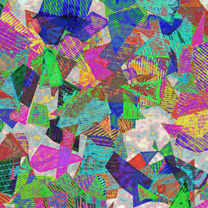
"""Create a 4096x4096 allRGB image resembling a pastel light micrograph of dopamine crystals.

This version is tuned to be closer to the provided reference image:
- softer pastel / pearly palette
- more faceted, plate-like crystal regions
- less swirly than the first crystal version
- still a strict allRGB image: every 24-bit RGB colour appears exactly once

Requires: numpy, pillow, scipy
Example:
    python dopamine_allrgb_crystals_v2.py --output dopamine_crystals_allrgb_v2.png --seed 17

Optional:
    python dopamine_allrgb_crystals_v2.py --save-scene scene_preview.png
"""

from __future__ import annotations

import argparse
import gc
import math
from pathlib import Path

import numpy as np
from PIL import Image, ImageFilter
from scipy.ndimage import gaussian_filter

SIZE = 4096
SCENE_SIZE = 1152
N = SIZE * SIZE


def hsv_to_rgb(h: np.ndarray, s: np.ndarray, v: np.ndarray) -> np.ndarray:
    h = np.mod(h, 1.0)
    s = np.clip(s, 0.0, 1.0)
    v = np.clip(v, 0.0, 1.0)

    i = np.floor(h * 6.0).astype(np.int32)
    f = h * 6.0 - i
    p = v * (1.0 - s)
    q = v * (1.0 - f * s)
    t = v * (1.0 - (1.0 - f) * s)
    i %= 6

    r = np.empty_like(v)
    g = np.empty_like(v)
    b = np.empty_like(v)

    m = i == 0
    r[m], g[m], b[m] = v[m], t[m], p[m]
    m = i == 1
    r[m], g[m], b[m] = q[m], v[m], p[m]
    m = i == 2
    r[m], g[m], b[m] = p[m], v[m], t[m]
    m = i == 3
    r[m], g[m], b[m] = p[m], q[m], v[m]
    m = i == 4
    r[m], g[m], b[m] = t[m], p[m], v[m]
    m = i == 5
    r[m], g[m], b[m] = v[m], p[m], q[m]

    return np.clip(np.round(np.stack((r, g, b), axis=-1) * 255.0), 0, 255).astype(np.uint8)


def morton_encode_rgb(r: np.ndarray, g: np.ndarray, b: np.ndarray) -> np.ndarray:
    r = r.astype(np.uint32, copy=False)
    g = g.astype(np.uint32, copy=False)
    b = b.astype(np.uint32, copy=False)
    code = np.zeros(r.shape, dtype=np.uint32)
    for bit in range(8):
        code |= ((r >> bit) & 1) << (3 * bit + 2)
        code |= ((g >> bit) & 1) << (3 * bit + 1)
        code |= ((b >> bit) & 1) << (3 * bit)
    return code


def morton_decode_rgb(code: np.ndarray) -> tuple[np.ndarray, np.ndarray, np.ndarray]:
    code = code.astype(np.uint32, copy=False)
    r = np.zeros(code.shape, dtype=np.uint32)
    g = np.zeros(code.shape, dtype=np.uint32)
    b = np.zeros(code.shape, dtype=np.uint32)
    for bit in range(8):
        r |= ((code >> (3 * bit + 2)) & 1) << bit
        g |= ((code >> (3 * bit + 1)) & 1) << bit
        b |= ((code >> (3 * bit + 0)) & 1) << bit
    return r.astype(np.uint8), g.astype(np.uint8), b.astype(np.uint8)


def polygon_mask_bbox(height: int, width: int, points: np.ndarray):
    """Rasterize polygon into a bounding-box-sized boolean mask."""
    min_x = max(0, int(np.floor(points[:, 0].min())) - 2)
    max_x = min(width, int(np.ceil(points[:, 0].max())) + 3)
    min_y = max(0, int(np.floor(points[:, 1].min())) - 2)
    max_y = min(height, int(np.ceil(points[:, 1].max())) + 3)
    if min_x >= max_x or min_y >= max_y:
        return None

    from PIL import ImageDraw
    mask_img = Image.new('L', (max_x - min_x, max_y - min_y), 0)
    draw = ImageDraw.Draw(mask_img)
    pts = [(float(x - min_x), float(y - min_y)) for x, y in points]
    draw.polygon(pts, fill=255)
    mask = np.asarray(mask_img, dtype=np.uint8) > 0
    return min_x, max_x, min_y, max_y, mask


def make_crystal_scene(seed: int, small: int = SCENE_SIZE) -> np.ndarray:
    rng = np.random.default_rng(seed)
    h = w = small
    yy, xx = np.mgrid[0:h, 0:w].astype(np.float32)

    # Light microscope paper-white base with slight shading.
    base = np.ones((h, w, 3), dtype=np.float32) * 238.0
    large_noise = gaussian_filter(rng.normal(size=(h, w)).astype(np.float32), sigma=24)
    illum = 6.0 * large_noise / (np.std(large_noise) + 1e-6)
    for c in range(3):
        base[..., c] += illum

    # Build many overlapping faceted crystal plates.
    n_crystals = 180
    coverage = np.zeros((h, w), dtype=np.float32)

    pastel_hues = np.array([
        0.00, 0.04, 0.08, 0.12, 0.16, 0.22, 0.30, 0.44, 0.52, 0.58, 0.67, 0.75, 0.83, 0.92
    ], dtype=np.float32)

    print('Building faceted crystal scene...', flush=True)
    for _ in range(n_crystals):
        cx = rng.uniform(-60, w + 60)
        cy = rng.uniform(-60, h + 60)
        sides = int(rng.integers(4, 8))
        radius = rng.uniform(45, 180)
        angle0 = rng.uniform(0, 2 * np.pi)

        # Irregular polygon for crystal plate.
        angles = np.sort(rng.uniform(0, 2 * np.pi, sides)) + angle0
        radii = radius * rng.uniform(0.65, 1.25, sides)
        pts = np.stack([cx + np.cos(angles) * radii, cy + np.sin(angles) * radii], axis=1).astype(np.float32)
        bbox_data = polygon_mask_bbox(h, w, pts)
        if bbox_data is None:
            continue
        min_x, max_x, min_y, max_y, mask = bbox_data
        if mask.sum() < 150:
            continue

        # Local coordinates and crystal orientation.
        theta = rng.uniform(0, 2 * np.pi)
        c = math.cos(theta)
        s = math.sin(theta)
        xloc = xx[min_y:max_y, min_x:max_x]
        yloc = yy[min_y:max_y, min_x:max_x]
        dx = xloc - cx
        dy = yloc - cy
        u = dx * c + dy * s
        v = -dx * s + dy * c

        # Distance to center and to edges.
        rr = np.sqrt(dx * dx + dy * dy)
        # Use blur of mask to approximate plate depth and edge glow.
        mask_f = mask.astype(np.float32)
        soft = gaussian_filter(mask_f, sigma=rng.uniform(2.0, 5.0))
        edge = np.clip((soft - gaussian_filter(mask_f, sigma=8.0)) * 8.0, -1.0, 1.0)
        edge = np.abs(edge)

        # Faceted sub-planes: combine 2-3 directional band systems.
        f1 = rng.uniform(0.035, 0.095)
        f2 = rng.uniform(0.045, 0.13)
        f3 = rng.uniform(0.025, 0.085)
        phi1 = rng.uniform(0, 2 * np.pi)
        phi2 = rng.uniform(0, 2 * np.pi)
        phi3 = rng.uniform(0, 2 * np.pi)

        bands1 = 0.5 + 0.5 * np.sin(u * f1 * 10.0 + phi1)
        bands2 = 0.5 + 0.5 * np.sin((0.72 * u + 0.95 * v) * f2 * 10.0 + phi2)
        bands3 = 0.5 + 0.5 * np.sin((1.15 * v - 0.38 * u) * f3 * 10.0 + phi3)

        facets = 0.50 * bands1 + 0.32 * bands2 + 0.18 * bands3
        facets = gaussian_filter(facets.astype(np.float32), sigma=0.75)

        # Radial bursts like interference fans, but much softer than v1.
        ang = np.arctan2(dy, dx)
        burst_count = rng.integers(6, 18)
        burst = 0.5 + 0.5 * np.sin(burst_count * ang + rr * rng.uniform(0.06, 0.16) + rng.uniform(0, 2*np.pi))
        burst *= 0.45

        # Colour strategy: pastel pearly regions with local rainbow shifts.
        base_h = rng.choice(pastel_hues)
        hue = (base_h + 0.10 * (facets - 0.5) + 0.08 * (burst - 0.22)) % 1.0

        sat = 0.18 + rng.uniform(0.06, 0.22) + 0.26 * facets + 0.12 * burst
        sat *= rng.uniform(0.75, 1.10)
        sat = np.clip(sat, 0.06, 0.72)

        val = 0.70 + rng.uniform(0.02, 0.16) + 0.18 * facets + 0.14 * burst
        val += 0.12 * np.clip(soft, 0.0, 1.0)
        val -= 0.10 * edge
        val = np.clip(val, 0.22, 1.0)

        rgb = hsv_to_rgb(hue, sat, val).astype(np.float32)

        # Blend onto base with semi-transparency so plates stack like the reference.
        alpha = np.clip(0.34 + 0.42 * soft + 0.18 * facets, 0.0, 0.92)
        alpha *= mask_f
        alpha *= rng.uniform(0.68, 0.92)

        sub = base[min_y:max_y, min_x:max_x]
        for cch in range(3):
            sub[..., cch] = np.where(
                mask,
                sub[..., cch] * (1.0 - alpha) + rgb[..., cch] * alpha,
                sub[..., cch],
            )
        base[min_y:max_y, min_x:max_x] = sub

        coverage[min_y:max_y, min_x:max_x] += alpha

        # Add occasional fine crystal fractures/highlights.
        if rng.random() < 0.55:
            ridge = np.abs(np.sin((u * rng.uniform(0.08, 0.20) + v * rng.uniform(0.02, 0.08) + rng.uniform(0, 2*np.pi))))
            ridge = np.clip((ridge - 0.93) * 14.0, 0.0, 1.0) * mask_f
            ridge = gaussian_filter(ridge.astype(np.float32), sigma=0.55)
            sub = base[min_y:max_y, min_x:max_x]
            for cch in range(3):
                sub[..., cch] += ridge * rng.uniform(12, 28)
            base[min_y:max_y, min_x:max_x] = sub

    # Background should remain pale where crystals do not cover.
    uncovered = np.clip(1.0 - coverage / max(coverage.max(), 1.0), 0.0, 1.0)
    base[..., 0] += uncovered * 10.0
    base[..., 1] += uncovered * 8.0
    base[..., 2] += uncovered * 11.0

    # Gentle microscope diffusion and grain.
    base = np.clip(base, 0, 255)
    img = Image.fromarray(base.astype(np.uint8), 'RGB')
    img = img.filter(ImageFilter.GaussianBlur(radius=0.45))
    img = img.resize((SIZE, SIZE), Image.Resampling.LANCZOS)

    arr = np.asarray(img, dtype=np.float32)
    fine = rng.normal(0.0, 2.2, size=arr.shape).astype(np.float32)
    broad = gaussian_filter(rng.normal(size=(SIZE, SIZE)).astype(np.float32), sigma=22)
    broad = broad[..., None]
    arr += fine + 3.5 * broad / (np.std(broad) + 1e-6)

    # Small interference-like colour tinting.
    arr[..., 0] *= 1.012
    arr[..., 1] *= 0.998
    arr[..., 2] *= 1.014

    arr = np.clip(arr, 0, 255).astype(np.uint8)
    return arr


def save_scene_preview(scene: np.ndarray, path: str | Path) -> None:
    Image.fromarray(scene, 'RGB').save(path)
    print(f'Saved scene preview: {path}', flush=True)


def render_allrgb(seed: int, output: str | Path, save_scene: str | None = None, chunk: int = 500_000) -> None:
    scene = make_crystal_scene(seed)
    if save_scene:
        save_scene_preview(scene, save_scene)

    print('Computing colour-order keys for target scene...', flush=True)
    r = scene[..., 0].ravel()
    g = scene[..., 1].ravel()
    b = scene[..., 2].ravel()
    keys = morton_encode_rgb(r, g, b)
    del scene, r, g, b
    gc.collect()

    print('Sorting pixels by target colour structure...', flush=True)
    pixel_order = np.argsort(keys, kind='stable')
    del keys
    gc.collect()

    print('Assigning every RGB value exactly once...', flush=True)
    out = np.empty((N, 3), dtype=np.uint8)
    for start in range(0, N, chunk):
        end = min(start + chunk, N)
        codes = np.arange(start, end, dtype=np.uint32)
        rr, gg, bb = morton_decode_rgb(codes)
        out[pixel_order[start:end], 0] = rr
        out[pixel_order[start:end], 1] = gg
        out[pixel_order[start:end], 2] = bb
        if start == 0 or end == N or (start // chunk) % 8 == 0:
            print(f'  {end:,} / {N:,} colours assigned', flush=True)

    del pixel_order
    gc.collect()

    Image.fromarray(out.reshape(SIZE, SIZE, 3), 'RGB').save(output, optimize=False)
    print(f'Saved {output}: {SIZE} x {SIZE}, all {N:,} RGB colours exactly once.', flush=True)


def main() -> None:
    parser = argparse.ArgumentParser(description=__doc__)
    parser.add_argument('--output', default='dopamine_crystals_allrgb_v2.png', help='Final allRGB PNG output')
    parser.add_argument('--seed', type=int, default=17, help='Random seed for composition')
    parser.add_argument('--save-scene', default=None, help='Optional path to save the pre-allRGB crystal scene')
    parser.add_argument('--chunk', type=int, default=500_000, help='Chunk size for allRGB assignment')
    args = parser.parse_args()

    render_allrgb(seed=args.seed, output=args.output, save_scene=args.save_scene, chunk=args.chunk)


if __name__ == '__main__':
    main()